One of the most compelling applications of atmospheric water generation is also one of the least discussed: the ability to produce clean drinking water in locations with no pipe infrastructure whatsoever.
No mains connection. No water delivery. No dependency on any external supply. Just air, power, and a machine that turns one into the other. For remote properties, island developments, eco-lodges, and off-grid homesteads, this is not a luxury feature — it is the only viable path to consistent, high-quality drinking water.
What “off-grid” actually means for AWG
An AWG requires two inputs: air with adequate humidity, and electrical power. In a grid-connected property, power is a given. In an off-grid context, power comes from solar panels, wind generation, a generator, or a combination. The practical question is always: does your power generation capacity support the machine’s draw?
Power requirements by model
| Model | Daily output | Continuous draw | Solar panels needed (approx.) |
|---|---|---|---|
| AWG 12L | 12 litres | 200–280W | 4–6 × 300W panels |
| AWG 20L | 20 litres | 300–400W | 6–8 × 300W panels |
| AWG 100L | 100 litres | 1,000–1,400W | 20–28 × 300W panels |
| AWG 250L | 250 litres | 2,500–3,500W | 50–70 × 300W panels |
Solar panel estimates assume average tropical irradiance and a battery storage system that smooths overnight and low-light periods. These are indicative figures — a proper solar design requires a site-specific assessment.
Storage: the buffer between production and demand
AWG units produce water continuously rather than on demand in bursts. Output rate varies with humidity and temperature throughout the day, typically peaking in the warmer, more humid afternoon hours. This means storage is an important part of off-grid AWG planning.
- Water is available at any time of day regardless of current production rate
- Periods of lower humidity (dry season, cooler nights) are covered by reserve
- The machine can run continuously at its optimal rate rather than cycling on demand
For a 12L unit supplying a household of two people, a 50–100 litre holding tank provides 4–8 days of reserve at typical consumption rates.
Humidity: the non-negotiable variable
AWG works best where the air is consistently humid. For tropical and semi-tropical off-grid locations — islands, jungle properties, coastal sites — this is rarely a concern. For higher-altitude sites, desert-adjacent areas, or locations with pronounced dry seasons, humidity can drop to levels that significantly reduce AWG output. A site with 30% relative humidity may see output fall to 30–40% of rated capacity.
Before committing to AWG as a primary water source, it is worth collecting humidity data for the location across all seasons — not just the wet season when conditions are optimal.
In tropical Southeast Asia, AWG and off-grid living are a natural match. The conditions that make the climate challenging — heat and humidity — are precisely the conditions that make AWG most productive.
Site planning considerations
- Ventilation — AWG units require good airflow. A well-ventilated room or covered outdoor area is ideal. Enclosed spaces can affect ambient humidity and unit efficiency.
- Ambient temperature — units perform best between 15°C and 40°C. Most tropical off-grid sites are comfortably within this range.
- Power stability — AWG compressors are sensitive to significant voltage fluctuation. Good battery management and voltage regulation protect the machine and extend its lifespan.
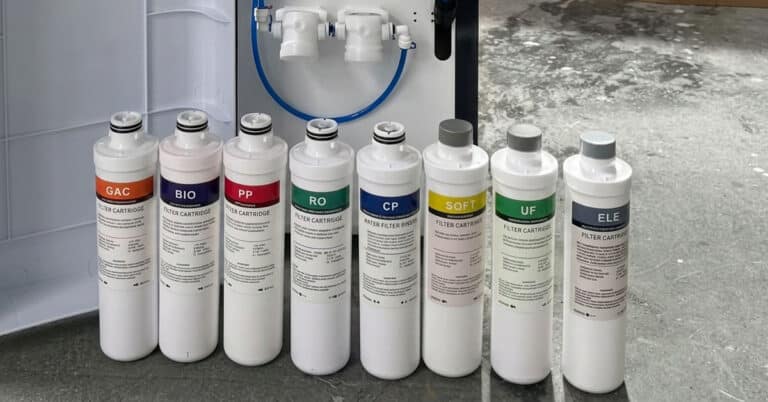
- Access for servicing — remote locations should maintain a filter stock on-site to avoid service delays between scheduled visits.
Combining AWG with other water sources
For off-grid sites in variable humidity climates, a hybrid approach makes sense: AWG as the primary source during humid periods, supplemented by rainwater harvesting with filtration during the wet season, and reserve storage to bridge dry periods. For consistently tropical sites, AWG alone is often sufficient for drinking and cooking water — the primary application.
Some of the most interesting AWG installations I have been involved with have been in genuinely remote locations — places where the water problem was previously solved by helicopter delivery or unreliable boat supply. The shift to on-site atmospheric generation changes the operational reality of those properties completely.