The question that comes up in almost every serious conversation about AWG is not about the technology — it is about the economics. “What does it actually cost to run?” It is a fair question, and it deserves a direct answer.
The short version: over any meaningful timeframe, AWG is significantly cheaper than bottled water. The longer version is worth understanding properly.
The three cost components
Running an AWG involves three ongoing costs: electricity, filter replacements, and periodic servicing. No water bills, no delivery fees, no plastic to dispose of.
Electricity
AWG units use electricity to run the compressor, fan, UV lamp, and — on residential units — the heating and cooling elements for hot and cold dispensing.
| Model | Daily output | Approx. power draw |
|---|---|---|
| AWG 12L | 12 litres | ~200–280W |
| AWG 20L | 20 litres | ~300–400W |
| AWG 100L | 100 litres | ~1,000–1,400W |
| AWG 250L | 250 litres | ~2,500–3,500W |
| AWG 500L | 500 litres | ~5,000–7,000W |
At Bali’s residential electricity rate of approximately IDR 1,444 per kWh (roughly $0.09 USD), a 12L unit running continuously costs approximately $0.50–0.65 USD per day in electricity — around $180–240 USD per year. For the 20L unit, expect $0.70–0.90 USD per day — roughly $255–330 USD per year.
Filter replacements
| Filter | Replacement interval |
|---|---|
| PPF pre-filters (5µm / 1µm) | Every 3–6 months |
| Activated carbon | Every 6–12 months |
| Mineral cartridge | Every 6–12 months |
| UV lamp | Every 12 months |
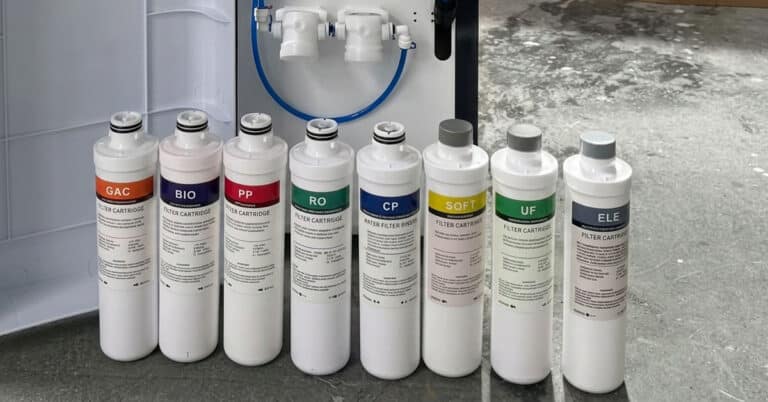
Filter kits for AquaFromAir residential units cost approximately $40–80 USD per year depending on the model and replacement frequency.
The real comparison: AWG vs bottled water
A household consuming 12 litres of drinking water per day and buying that water in 600ml bottles at typical Bali retail prices spends approximately $3.60 USD per day — $1,314 USD per year.
The same household running an AquaFromAir AWG 12L unit spends approximately $200 USD/year on electricity and $60 USD/year on filters — $260 USD total per year. That is a saving of over $1,000 USD per year, in addition to eliminating the plastic waste, the storage hassle, and the supply chain dependency.
A household that switches from bottled water to AWG typically recovers the machine’s cost within 12–18 months. After that, the savings compound indefinitely.
Cost-per-litre breakdown
| Source | Cost per litre (approx.) |
|---|---|
| Bottled water (Bali retail) | $0.25–0.40 USD |
| Gallon refill station | $0.05–0.10 USD |
| AWG 12L (electricity + filters) | $0.05–0.07 USD |
| AWG 20L (electricity + filters) | $0.04–0.06 USD |
| AWG 100L+ (electricity + filters) | $0.02–0.04 USD |
At scale, AWG becomes increasingly competitive. For commercial operations producing 100+ litres per day, the cost-per-litre drops to a level that bottled water or gallon delivery cannot match — with consistent quality that neither of those sources can guarantee.
What about servicing?
Beyond consumable filters, AWG units benefit from an annual service check — cleaning of the condensation system, inspection of the UV lamp, and verification of output quality via TDS meter. AquaFromAir’s 1-year full warranty covers parts and labour for the first year. After that, the ongoing service requirement is modest.
The numbers that matter most
The total cost of AWG ownership — machine, electricity, filters, servicing — over three years is typically less than two years of bottled water spending for an equivalent household. Over five years, the saving is substantial. For businesses, the calculus is even more compelling: higher daily consumption volumes, lower per-litre costs, and consistent water quality that bottled supply cannot reliably provide.
The economics of AWG were one of the things that surprised me most when I first ran the numbers seriously. The machine cost is visible and upfront — the bottled water cost is invisible because it arrives in small daily amounts. Adding it up for the first time is usually a revealing exercise.