Most people in Bali reach the same conclusion through trial and error. Tap water is not an option. Bottled water is the default. At some point the cost and the plastic pile up enough to prompt the question: is there a better way? This post does not repeat what is wrong with tap water, that is covered in detail elsewhere. This is the financial case. Four options, real numbers, a straight answer on which makes sense for whom.
// TL;DR — the short version— Tap water: Not safe to drink without treatment. Not an option.
— Bottled water: Convenient but expensive long-term, plastic-heavy, quality varies with storage.
— Reverse Osmosis: The cheapest installed option. Good quality. Depends on a source, pipe or well.
— AWG: Not the cheapest option. But the best quality, zero plastic, fully independent of any water source. The strongest long-term choice for drinking water specifically.
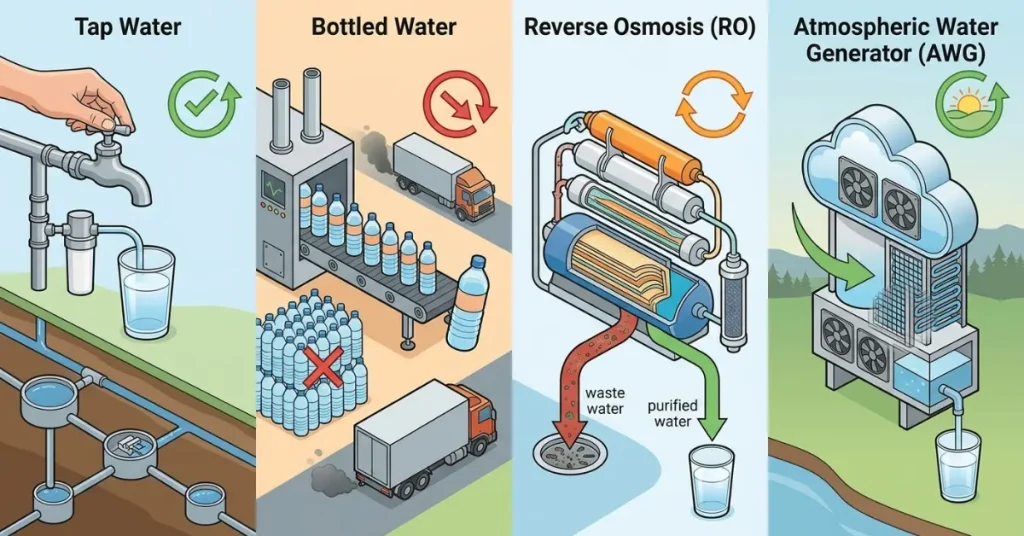
The four options at a glance
- Tap water — municipal supply. Widely available in urban Bali, absent in many rural and remote areas. Not safe to drink without treatment. TDS typically 500–1,000 PPM. Cost near zero, but the health risk makes it a non-starter as a drinking water source without further treatment.
- Bottled water — the default across Bali and much of Indonesia. Ranges from 600ml single-use bottles to large 19L branded jugs (Aqua, Club, and similar). Available everywhere, no infrastructure needed. High recurring cost, significant plastic waste, and quality that varies with storage conditions.
- Reverse osmosis (RO) filter — an installed system that pushes an existing water source through a semi-permeable membrane, removing the majority of contaminants. The source can be municipal pipe infrastructure or a deep well. Produces clean water at low per-litre cost once installed, but only as good as what goes into it — and produces 3–4 litres of waste water per litre purified.
- Atmospheric water generation (AWG) — extracts moisture from ambient air through condensation, purifies through multi-stage filtration and UV sterilisation. No source dependency, no plastic waste, consistent output quality. Higher capital cost than RO, higher electricity draw than all other options.
Water quality: What does each option actually deliver?
| Option | Typical TDS (PPM) | Contamination risk | Consistency |
|---|---|---|---|
| Tap water (Bali) | 500–1,000 | High — bacteria, metals, THMs | Low — varies by district and season |
| Bottled water (19L jug) | 50–200 | Low–medium — microplastics, storage conditions | Medium — brand and batch dependent |
| RO filter | 10–50 | Low — limited by membrane quality and source | High if maintained, drops with membrane age |
| AWG (AquaFromAir) | ~10 | Very low — no source contamination vector | Very high — independent of supply network |
For a deeper breakdown of TDS and what these numbers mean in practice, see What is TDS and why it matters.
The cost comparison; year 1, year 3, year 5
Based on a household consuming approximately 10 litres of drinking water per day in Bali. Large bottled jug based on IDR 40,000 (~$2.50 USD) per 19L. All figures in USD.
| Option | Year 1 total | Year 3 total | Year 5 total |
|---|---|---|---|
| Bottled water (600ml single-use) | $1,095–1,460 | $3,285–4,380 | $5,475–7,300 |
| Bottled water (19L jug @ IDR 40,000) | ~$480 | ~$1,440 | ~$2,400 |
| RO filter (install + running costs) | $600–900 | $900–1,350 | $1,200–1,800 |
| AWG 20L (machine + electricity + filters) | $1,800–2,200 | $2,500–3,000 | $3,200–3,800 |
Single-use bottled water is by far the most expensive option over any timeframe. The 19L jug is cheaper per litre but still compounds significantly — and comes with the same plastic dependency and storage quality risks. AWG has a higher year-1 cost due to the machine purchase, but by year 3 it tracks close to sustained 19L jug costs while delivering significantly better and more consistent water quality with zero plastic waste.
By year 3, a household that switched from single-use bottled water to an AquaFromAir unit has typically saved enough to cover the machine cost — and continues saving every year after that.
What the numbers do not show
- Source dependency (RO) — whether connected to municipal pipes or a deep well, an RO system is only as clean as its input. Membrane performance degrades with heavily contaminated source water. If the source is cut off or becomes unusable, the system stops producing.
- Plastic waste — a household buying 10 litres per day in 600ml bottles generates approximately 6,000 bottles per year. Even the 19L jug format generates significant plastic volume at scale, with repeated handling and inconsistent storage hygiene.
- Microplastic exposure — bottled water stored in heat leaches plastic particles into the water. The per-litre microplastic load in bottled water is, on average, higher than tap water — a health cost that does not appear in any price comparison.
- Supply chain risk — bottled water in both formats depends on external delivery and quality control. Supplier changes, delivery gaps, and storage conditions introduce variability that is invisible until something goes wrong.
The verdict
To be direct: RO is the cheapest installed water solution. If cost is the primary consideration and you have a reliable source — whether municipal pipes or a clean deep well — RO delivers good quality water at a low total cost of ownership. It is a legitimate and sensible choice for many households.
AWG is not trying to compete on price. It is a different proposition: the best available quality for drinking water specifically, with no dependency on any external source and no plastic waste. The water is created from air — it never touches a pipe, a well, or a storage container before it reaches your glass.
Some properties use both: RO for general water needs and washing, AWG specifically for drinking and cooking. That is a practical and honest approach — each technology doing what it does best.
Bottled water, at any scale beyond occasional use, is the worst long-term choice by almost every measure: cost over time, environmental impact, and microplastic exposure. The fact that it remains the default is a function of familiarity, not logic.
Running these numbers for the first time is usually the moment the decision becomes obvious. The machine cost is visible — it sits in the quote. The bottled water cost is invisible because it arrives five dollars at a time. Add it up over a year, then over five years, and the comparison answers itself.