Reverse osmosis and atmospheric water generation are both serious water purification technologies — and they are frequently compared by people trying to make an informed decision about their water supply. The comparison is worth doing properly, because the differences go well beyond technical specification.
What they have in common
Both AWG and RO produce water that is dramatically cleaner than what comes out of a municipal tap in most of Asia. Both use multi-stage filtration. Both are capable of achieving very low TDS (total dissolved solids) readings. And both are far better long-term choices than buying bottled water indefinitely.
That is where the meaningful similarities end.
How reverse osmosis works
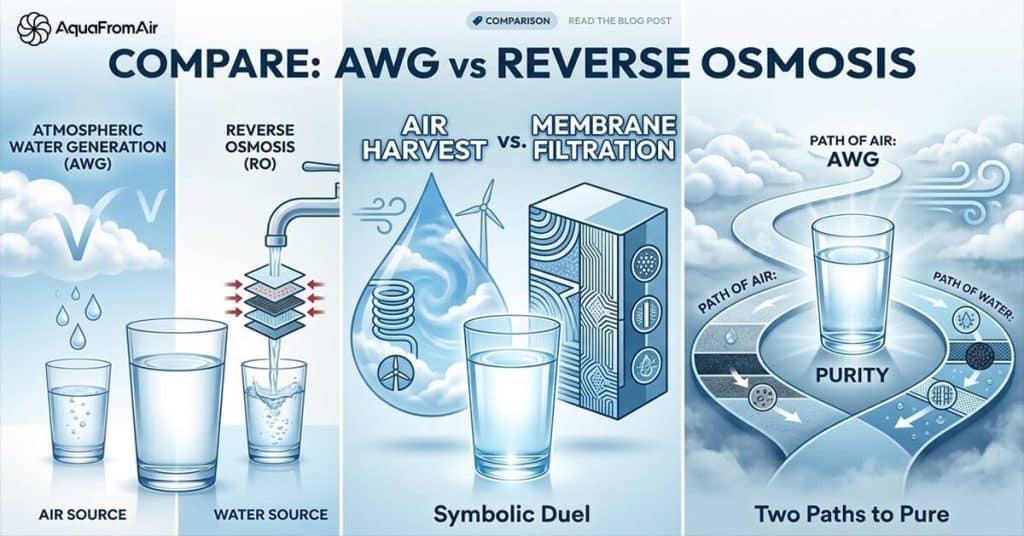
RO pushes existing water through a semi-permeable membrane under pressure. The membrane rejects dissolved solids, heavy metals, bacteria, and most contaminants — producing purified water on one side and a concentrated waste stream on the other.
The input is your existing water source: municipal tap, a well, rainwater collection. RO makes that source cleaner. It cannot create water where none exists.
How AWG works
An atmospheric water generator extracts moisture from ambient air through condensation, then purifies what it collects through a multi-stage filtration and UV sterilisation sequence.
There is no source water. No pipe connection. No dependency on infrastructure of any kind. The water is created, not filtered.
Source dependency: the critical difference
RO is only as good as its input. If source water contains PFAS compounds, certain industrial chemicals, or microplastics at very fine scales, a standard RO membrane may not capture everything. Membrane integrity matters, pre-filter maintenance matters, and if the source becomes unavailable or too compromised to treat — the system stops.
AWG has no source to worry about. As long as there is humid air — which in tropical climates is a constant — the machine produces water. The quality of that output does not vary with what is in the local supply network, because it is not connected to it.
Water quality: side by side
| Metric | RO (well-maintained) | AquaFromAir AWG |
|---|---|---|
| TDS output | 10–50 PPM | ~10 PPM (Bali field) |
| Microplastic risk | Reduced by filtration | Absent from source |
| PFAS removal | Partial (membrane dependent) | Not a source vector |
| Mineralisation | Stripped (add-back required) | Mineral cartridge included |
| Bacterial risk | Eliminated by membrane | Eliminated by UV sterilisation |
| Waste water | 3–4 litres per litre produced | None |
The core quality advantage of AWG is what was never in the water to begin with. Atmospheric moisture does not carry dissolved heavy metals, agricultural runoff compounds, or legacy pipe contaminants. RO removes these from a compromised source — AWG never encounters them.
Installation requirements
- RO requires a pressurised water supply, drain connection for waste, and adequate space for storage tank and housing.
- AWG requires a power supply and air. No plumbing connection. Can be installed anywhere with adequate humidity and electricity — including locations where pipe infrastructure does not reach.
Running costs
RO has lower electricity consumption per litre produced. However, membrane replacement, pre-filter changes, and servicing costs — particularly with poor source water — add up significantly over time.
AWG uses more electricity — the AWG 20L generator power requirement is roughly comparable to a powered on standard air conditioning unit. Factor in the elimination of bottled water purchasing, and the cost-per-litre economics are competitive over any meaningful timeframe.
When RO still makes sense
If you have a reliable, relatively clean water source and want to improve its quality at low capital cost — RO is a capable, well-understood solution. For plumbed residential settings with decent source water, it does the job.
But for true water independence, zero source dependency, no waste stream, and consistent quality regardless of local supply conditions — AWG is the only system that delivers all of that.
The question “how do I clean this water?” has a ceiling. The question “what if I did not need a source at all?” does not.
Having spent years installing and maintaining RO systems before making the full switch to AWG, the shift was driven by one simple realisation: filtering a compromised source is always a partial solution. Starting from air is not.